

The short answer: To catch a burglar on camera, mount your main unit at face height covering the direct approach to your door, then add coverage at the side gate, driveway, and any blind spot where someone could work unseen for more than a few seconds — most UK break-ins involve testing a property from an angle no single front-door camera reaches.
Table of Contents
Quick Summary
| Position | What It Catches | Priority |
|---|---|---|
| Front door, eye level | Face, clothing, direct approach | Essential |
| Side gate / alley access | Rear access attempts | High |
| Driveway / car port | Vehicle theft, casing behaviour | High |
| Garden shed / outbuilding | Tool theft, secondary targets | Medium |
| Boundary fence line | Perimeter breach, early warning | Medium |
| Porch roofline (wide angle) | Package theft, doorstep activity | High |
| Garage door / side access | Forced entry attempts | Medium |
What Is the Best Camera Angle to Catch a Burglar on Camera?
The best camera angle sits at roughly face height (4–5ft / 1.2–1.5m) and points slightly downward across the natural approach path to your property, rather than straight ahead. This captures a clear, front-on view of anyone's face as they walk toward the door, instead of the top of their head or a side profile that's useless for identification.
After 20 years working security, the pattern I've seen repeatedly is cameras mounted too high — usually to keep them out of reach — which technically "sees" the intruder but only from an angle that a facial recognition system, or a police officer reviewing the footage, can't actually use. Height matters less than angle. A camera at 8ft pointed straight down the path gives you a clear view of the top of someone's cap. A camera at 4.5ft angled slightly downward gives you a face.
The 7 Best Camera Positions to Catch a Burglar on Camera
Most UK homes only think about the front door. A determined intruder doesn't approach from the front — they check every angle first. These seven positions cover the ones that actually get tested.
1. Front door, eye level Your primary camera, whether a Ring Battery Doorbell Plus or Eufy E340, should sit at 1.2–1.5m and cover the direct approach path, not just the doorstep itself. This is the position that captures a clear face on anyone who rings the bell, tests the handle, or lingers before deciding whether to knock.
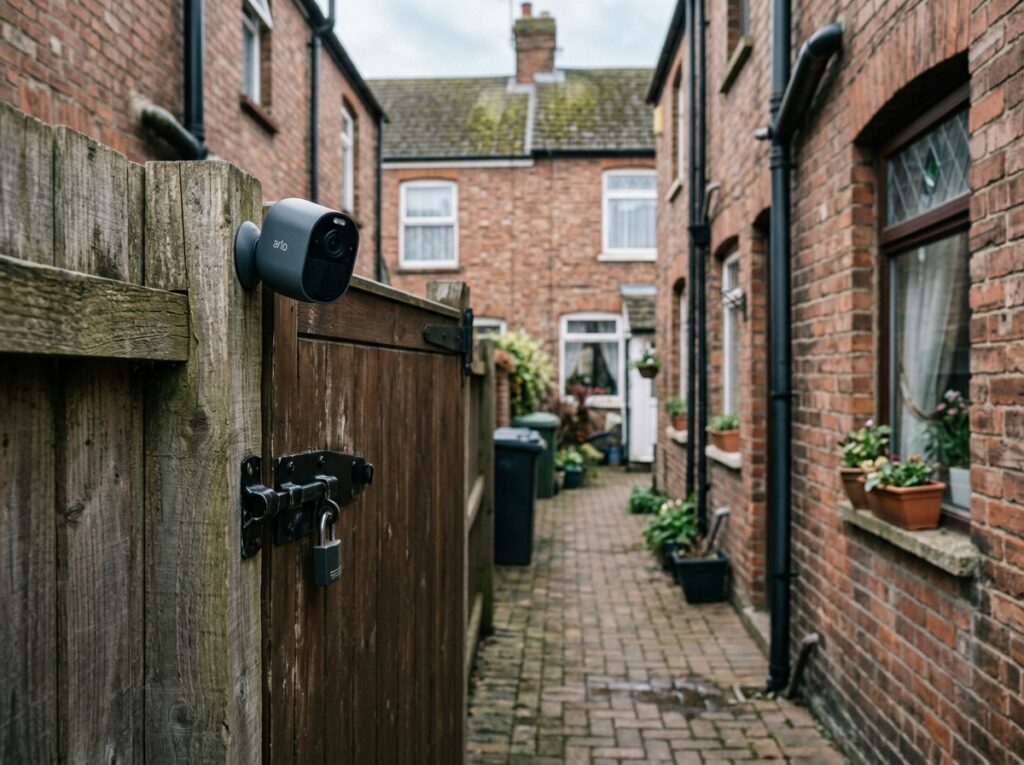
2. Side gate or alley access Terraced and semi-detached UK houses almost always have a side gate leading to the back garden — and it's rarely covered by the main doorbell. This is one of the most common points intruders test first, precisely because it's out of view from the street and usually from the doorbell too.
3. Driveway or car port A driveway camera catches vehicle theft, catalytic converter theft, and — just as usefully — the casing behaviour that precedes a break-in. Someone walking slowly along a driveway, checking windows, or photographing the property is a pattern worth having on record even before anything is actually stolen.
4. Garden shed or outbuilding Sheds get targeted for power tools, bikes, and garden equipment far more often than people expect, and they're almost never covered by a doorbell camera at the front of the house. A cheap secondary camera here closes a genuine gap.
5. Boundary fence line A camera angled along your fence line, rather than at the house itself, gives you early warning of someone approaching before they reach any door or window. This is less about identification and more about knowing something's happening before it escalates.
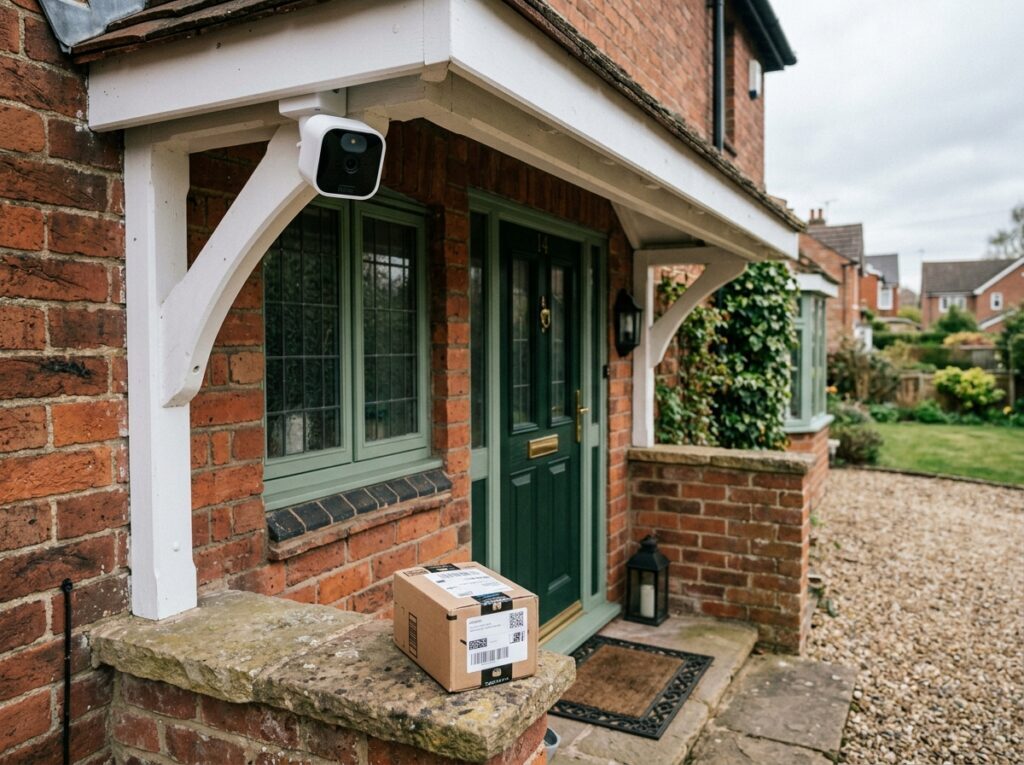
6. Porch roofline, wide angle A wider-angle camera mounted under the porch roof, rather than at the door itself, captures the whole doorstep — useful specifically for parcel theft, where the action often happens a metre or two away from where a standard doorbell camera is aimed. See our guide on catching a parcel thief on camera for what to do if this position pays off.
7. Garage door or side access Forced entry through a garage side door is a common secondary route once someone's ruled out the front. A camera here, even a basic one, covers an access point most homeowners never think to check.
Where Are the Most Common Camera Blind Spots at UK Front Doors?
The most common camera blind spots are directly beneath the doorbell itself, along the boundary where a front garden meets the pavement, and anywhere a wall or hedge interrupts the field of view — all places a single front-door camera simply can't see.
Most video doorbells have a limited downward field of view, which means anyone standing right at the door — reaching for a package, testing a lock, or crouching below the frame — can sit in a blind spot inches from the lens. Hedges, bins, and porch pillars create smaller blind spots that are easy to miss during installation because they only become obvious once you check the recorded footage rather than the live preview. Walk your own approach path and watch the live view from your phone before finalising any mounting position — it's the fastest way to catch a blind spot before it matters.
What Is the Best Doorbell Camera Height for Facial Capture?
The best doorbell camera height for facial capture is 1.2–1.5m (4–5ft) from the ground, angled slightly downward — high enough to avoid casual tampering, low enough to capture a face rather than the top of a head.
This range works because it roughly matches average adult eye level, so the camera sees faces the way a person standing at the door would. Go higher — a common instinct for security — and you trade identification quality for a wider, safer-feeling view that mostly shows hairlines and shoulders. If vandalism or reach is a genuine concern in your area, a wire cage or a recessed mount protects the camera without forcing you to mount it out of useful range.
Where Should You Position a Camera to Catch a Package Thief on Camera?
To catch a package thief on camera, position a wide-angle unit that covers the entire doorstep area — not just the door itself — since most parcel theft happens a step or two away from where a standard doorbell is aimed, right where the courier actually leaves the box.
A doorbell camera pointed straight at the door often misses this by design — it's optimised to see visitors approaching, not packages sitting to one side. A second, wider-angle camera under the porch roofline, or a doorbell model with a wide field of view like the Arlo Video Doorbell 2K, closes this gap. Combine this with a secure delivery box or a request for packages to be left out of direct street view, and you address both the visibility and the opportunity side of parcel theft.
Do You Need More Than One Camera to Cover Your Property?
For most UK terraced and semi-detached homes, one well-placed doorbell camera covers the front approach, but a second camera at the side gate or rear access point closes the single biggest gap — the one intruders are most likely to test first specifically because it's unmonitored.
You don't need a full CCTV system to get meaningful coverage. A doorbell camera at the front plus one affordable secondary camera at the side or rear access point covers the two points most likely to be tested. From there, additional cameras at the driveway, shed, or boundary line are worthwhile upgrades rather than essentials — add them based on what your specific property actually exposes, not a generic checklist. If you're deciding between a doorbell-only setup and something more comprehensive, our video doorbell vs CCTV comparison breaks down when each makes sense.
Frequently Asked Questions
Does camera placement actually deter burglars, or just record them? Both. Visible, well-placed cameras are a genuine deterrent on their own — see our research on whether video doorbells deter burglars — and if deterrence fails, good placement is what turns footage into something actually usable afterward.
Should I hide my cameras or make them visible? Visible. A camera someone can see is doing deterrence work before anything happens. Hidden cameras only pay off after the fact, and by then the goal has already shifted from prevention to evidence.
Can a wide-angle lens replace multiple cameras? Partially. A wide field of view helps with a single position like the front door, but it can't see around corners, gates, or the back of a house — those genuinely need a separate camera pointed the right way.
What's the single most overlooked camera position on a UK property? The side gate or alley access. It's almost never covered by a standard doorbell, and it's one of the first things a determined intruder checks precisely because it's out of view from the street.
Does mounting height matter more than camera resolution? For identification purposes, yes. A lower-resolution camera at the right height and angle captures a usable face far better than a 4K camera mounted too high or angled wrong.
For more on where exactly to mount your primary camera, see our full guide to video doorbell height and angle.
As an Amazon Associate, we earn from qualifying purchases at no extra cost to you. Prices correct at time of writing and verified on Amazon UK. Some images on this site are AI-generated and may not reflect the exact appearance of the products described.