

The short answer: Can my landlord stop me installing a video doorbell? In most cases — no. There is no law in England that gives your landlord the automatic right to refuse a battery-powered video doorbell that causes no permanent damage to the property. But your tenancy agreement might say otherwise, and how you ask matters as much as what you're asking for.
Table of Contents
Can My Landlord Stop Me Installing a Video Doorbell?
After 20 years working in UK security, I've heard this question from renters more than almost any other. The honest answer is: it depends — on your tenancy agreement, your installation method, and whether your landlord is reasonable.
Here's what actually matters, in plain English, without the legal jargon.
Fact 1: There Is No Law That Automatically Bans Doorbell Cameras in Rented Properties
No statute in England, Wales, Scotland, or Northern Ireland specifically prohibits a tenant from installing a video doorbell. The law doesn't mention doorbells at all.
What the law does govern is:
Alterations to the property. Most tenancy agreements include a clause prohibiting "alterations" or "modifications" without landlord consent. Whether a battery doorbell counts as an "alteration" is a grey area — and the answer usually depends on how it's installed.
Data protection. UK GDPR applies if your doorbell captures footage beyond your front door — a public pavement, a neighbour's property, or a communal hallway. This affects you as the data controller, not your landlord. See our full GDPR guide for what this means in practice.
Privacy. Your landlord cannot install surveillance cameras in your property without your consent. But this protection runs both ways — your camera must not capture areas your neighbours or landlord consider private.
The practical reality: most landlords who object do so because they're worried about damage to the property — holes, marks, or cable runs. A battery doorbell installed with care causes essentially none of these.
Fact 2: Installation Method Makes All the Difference
The most important thing you can do before asking your landlord for permission is decide how you're going to install the doorbell.
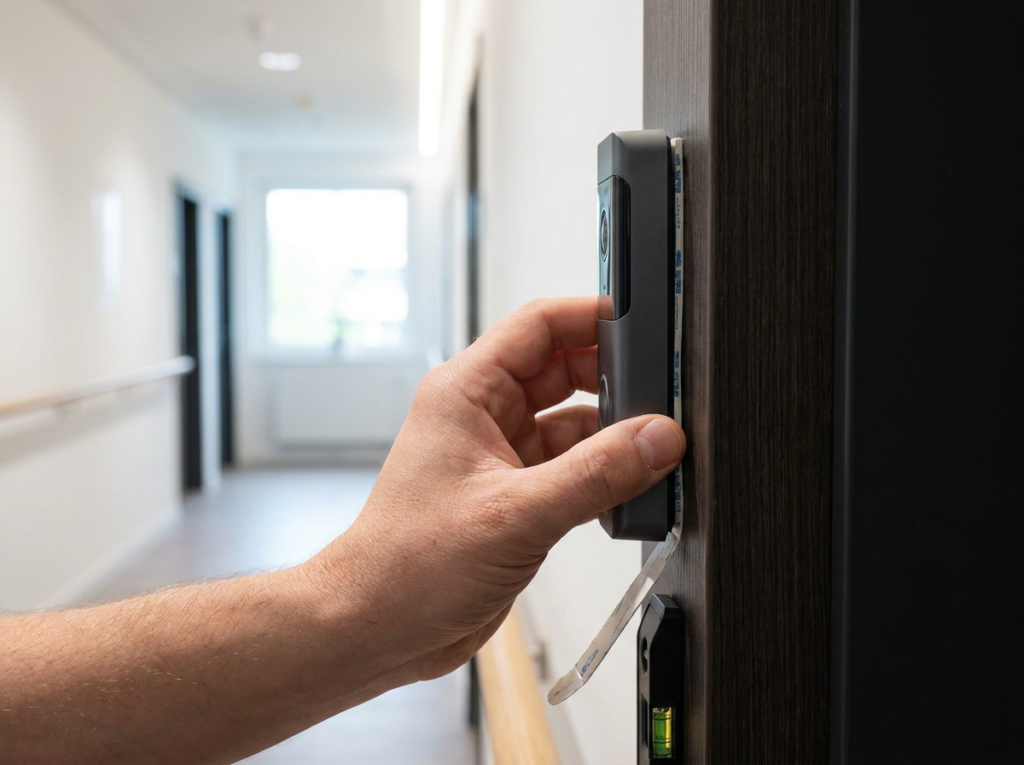
Battery + adhesive mount — lowest risk, easiest approval: Some doorbells — and many aftermarket accessories — mount using high-strength adhesive strips rather than screws. No holes, no damage, completely reversible. If you're asking your landlord for permission, lead with this. A landlord who says no to "drilling into the door frame" may say yes to "I'll use an adhesive bracket that I can remove without a trace when I leave."
Battery + screws — low risk, ask first: Two small screw holes in brick or render are easily filled with the correct filler when you leave. This is the most common battery doorbell installation and is generally considered a "minor" alteration in most tenancy agreements. Many landlords will approve this without hesitation. Get it in writing.
Wired installation — higher risk, always ask: Running cables, drilling through walls, and connecting to an existing transformer is a meaningful modification. This absolutely requires landlord consent — and potentially a qualified electrician. Without permission, you could be held liable for the cost of reinstatement.
For most renters, a battery doorbell is the right answer. See our installation guide for the full process.
Fact 3: Your Tenancy Agreement Is the Starting Point — Not the Ending Point
Before asking your landlord anything, read your tenancy agreement. Specifically, look for:
"Alterations" or "modifications" clauses — most agreements say you cannot make alterations without written consent. A battery doorbell may or may not fall under this, depending on the installation method and how your landlord interprets the clause.
"Fixtures and fittings" clauses — some agreements specify you cannot install or remove fixtures. A doorbell mounted with screws may technically be a fixture once installed.
"CCTV" or "surveillance" clauses — less common, but some modern tenancy agreements specifically address cameras and recording equipment.
If your tenancy agreement is silent on all of these — which is common in older agreements — you're in a stronger position. The absence of a prohibition isn't permission, but it gives you much more room to negotiate.
The Renters' Rights Act 2025 — what changed from 1 May 2026:
The Renters' Rights Act 2025 gives private tenants in England stronger protections from 1 May 2026 — including the right to request pets (which landlords cannot unreasonably refuse) and protection from no-fault evictions.
While the Act doesn't specifically address doorbells, the general principle it establishes — that landlords cannot unreasonably refuse reasonable tenant requests — is relevant context. A landlord who refuses a battery doorbell that causes no damage to the property would struggle to justify that refusal as "reasonable."
Fact 4: How to Ask Your Landlord — and What to Say
Most landlords who object to video doorbells do so out of uncertainty, not principle. They don't know what you're installing, they worry about damage, and they worry about their own privacy or liability. Address these concerns directly and you'll often get a yes.
Ask in writing — always. Email or letter, not a phone call. You want a record. If your landlord approves verbally and later disputes it when you leave, you have no evidence.
Describe the installation method specifically. Don't just say "I want to install a video doorbell." Say: "I'd like to install a battery-powered Eufy E340 video doorbell using two small screws into the brickwork beside the front door. I'll fill the holes with appropriate filler when I leave and restore the area to its original condition."
Reassure about GDPR. Some landlords have vague concerns about cameras and "spying." Mention that you'll angle the camera to cover only your front door and will comply with UK GDPR. This shows you've thought it through.
Offer to remove it. State explicitly that you'll remove the doorbell and restore the mounting area at the end of your tenancy, at your own cost.
A template message:
"Dear [Landlord], I'm writing to request permission to install a battery-powered video doorbell at [address]. I'd like to use a [model name] — it runs on rechargeable batteries, requires no wiring, and mounts with two small screws into the brickwork. The camera will only cover my front doorstep. I'll fill any screw holes and restore the area to its original condition when I leave. Please let me know if you're happy for me to proceed. Kind regards, [Name]"

Fact 5: What Happens If Your Landlord Says No
If your landlord refuses and you believe the refusal is unreasonable, you have options — but they require careful handling.
Request a reason in writing. A landlord who refuses without reason is in a weaker position. If they give a reason — "I don't want any holes in the walls" — you can respond by proposing an adhesive mount instead.
Propose a compromise. No-drill adhesive mounting. A doorbell pointed only at your flat door, not a communal area. A specific model they can inspect before approval. Most reasonable landlords will engage with a reasonable compromise.
Consider the Renters' Rights Act context. From May 2026, landlords cannot unreasonably refuse reasonable requests — this principle, applied to pets in the Act, sets a broader expectation for tenancy disputes. An unreasonable refusal of a no-damage battery doorbell is harder to justify in 2026 than it was before.
Seek advice from Shelter or Citizens Advice. Both offer free housing advice and can help you understand whether a specific refusal is reasonable in the context of your tenancy agreement and current law.
Don't install without permission if refused. If your landlord explicitly says no and you install anyway, you're in breach of your tenancy agreement — regardless of whether you believe the refusal is reasonable. The risk to your deposit and tenancy isn't worth it.
Communal Areas and Flats — Extra Complexity
If you live in a flat or apartment, the situation is more complex. Your front door may open onto a communal hallway — an area shared with other residents, owned by the building management or freeholder, not just your landlord.
Communal hallways: Installing a camera that records a communal area requires permission from the building management or freeholder, not just your landlord. It also requires compliance with UK GDPR for shared spaces — which is more complicated than a private doorstep.
Your flat door vs the building entrance: Many flat-dwellers want a doorbell at the main building entrance rather than their flat door. This almost always requires building management permission and may not be practical at all.
The practical solution for flats: A video doorbell at your flat door (communal hallway side) is possible with the right model and permission, but requires careful GDPR handling. An internal camera covering your flat entrance from inside is simpler legally — though less useful for security. See our guide for flats for the full breakdown.
The Best Video Doorbells for Rented Properties
If you're a renter, battery-powered models with minimal installation requirements are the right choice. These cause the least concern for landlords and are the easiest to remove and restore when you leave.
Eufy Video Doorbell E340 — Best Overall for Renters Dual cameras, 8GB built-in storage, no subscription, no wiring. Mounts with screws into brickwork — the minimal installation that most landlords will accept. Read our full E340 review for more.
Ring Battery Doorbell Plus — Best for Alexa Renters The most landlord-friendly installation: removable battery, no wiring, simple screws. The Ring app is the most polished. Subscription required for full functionality. Read our full Ring review.
Aqara Video Doorbell G4 — Best for Apple HomeKit Renters The only battery-powered HomeKit Secure Video doorbell. Runs on AA batteries — no charging cable, no wiring. Footage encrypted in iCloud. Ideal for Apple households in rented properties. See our HomeKit doorbell guide for more.
For a full comparison of battery models suitable for renters, see our video doorbell for rented property guide.
Head-to-Head — Renter-Friendly Doorbells
| Eufy E340 | Ring Battery Plus | Aqara G4 | |
|---|---|---|---|
| Price | ~£160 | ~£130 | ~£120 |
| Monthly fee | None | £4.99 | None |
| Installation | Screws (no wiring) | Screws (no wiring) | Screws (no wiring) |
| Battery | Removable | Removable | AA batteries |
| Local storage | ✅ 8GB built-in | ❌ Cloud only | ✅ microSD in chime |
| HomeKit | ❌ | ❌ | ✅ HKSV |
| Dual camera | ✅ | ❌ | ❌ |
| IP rating | IP65 | not stated | not stated |
My Verdict
After 20 years in UK security, my advice to renters is simple: ask properly and you'll usually get yes.
Most landlords aren't opposed to video doorbells — they're opposed to damage, liability, and surprises. Remove those concerns and a reasonable landlord will almost always say yes.
Ask in writing. Describe the installation specifically. Offer to restore on departure. Propose an adhesive mount if they hesitate.
And if they say no without a reasonable reason — you're in a stronger position in 2026 than you've ever been, with the Renters' Rights Act setting a clearer expectation that landlord refusals must be justified.
For the full picture on renting and home security, see our parcel theft guide and our GDPR obligations guide — both are essential reading for renters installing cameras.
Frequently Asked Questions
Can my landlord stop me installing a video doorbell? There is no law that automatically gives your landlord this right. However, your tenancy agreement may have an "alterations" clause requiring written consent. Check your agreement first, then ask in writing. A landlord who refuses a no-damage battery doorbell without reason may be acting unreasonably under the Renters' Rights Act 2025.
Do I need to ask permission to install a Ring doorbell in a rented property? Yes — if your tenancy agreement includes an alterations clause. Even if it doesn't, asking in writing and getting approval protects you from deposit disputes when you leave. Use a battery model, describe the installation method precisely, and offer to restore on departure.
Can I install a video doorbell without drilling in a rented property? Yes — adhesive mounting brackets are available for most doorbell models. High-strength adhesive strips cause no damage and are completely reversible. This is the easiest route to landlord approval.
What happens if I install a doorbell without permission? If your tenancy agreement requires landlord consent for alterations and you install without asking, you're in breach of your agreement. Your landlord could deduct restoration costs from your deposit, and in extreme cases it could be grounds for a possession claim. Always ask first.
Does the Renters' Rights Act 2025 affect my right to install a doorbell? Not directly — the Act doesn't mention doorbells. But it establishes the principle that landlords cannot unreasonably refuse reasonable tenant requests (specifically for pets, but the principle has broader relevance). An unreasonable refusal of a no-damage battery doorbell is harder to justify in 2026 than before the Act.
Can I install a video doorbell in a communal hallway in a flat? This requires permission from both your landlord and the building management or freeholder. It also raises GDPR complications around recording shared spaces. See our guide for flats for the full breakdown.
Last updated: June 2026. This article provides general information only and does not constitute legal advice. For specific tenancy disputes, seek advice from Shelter, Citizens Advice, or a qualified solicitor. As an Amazon Associate, we earn from qualifying purchases at no extra cost to you.